
Save on a New HVAC System
Proudly Serving


See what our past customers are saying about our water heater skills
Tank versus tankless. 40 gallon versus 50 gallon models. Natural gas versus propane. Installation costs. Maintenance requirements. Replacement timing.
The final decision belongs to you.
Understanding Your Gas Water Heater Options
Tank vs Tankless Gas Water Heaters
Storage tanks dominate the market. They hold water at constant temperature. Ready when you need it.
Traditional tank models cost USD 300 to USD 2,000 from a box store. Installation runs USD 500 to USD 2,000. These units last 10 to 15 years with proper care.
Tankless systems heat on demand. No running out of hot water. The catch: flow rate limits.
Tankless units deliver 2 to 5 gallons per minute. Gas models outperform electric versions. Purchase price: USD 1,900 to USD 5,000. Complex installations reach USD 2,800.
The payoff comes through lower bills. Homes using 41 gallons or less daily see 24% to 34% energy savings.
40 Gallon Gas Water Heater for Smaller Homes
Perfect for households with 2 to 3 people.
First-hour rating: 65 to 70 gallons. You get more hot water than the tank holds. Recovery matters here. 40,000 BTU input recovers 35 to 40 gallons per hour.
Purchase prices: USD 400 to USD 900.
The sweet spot for couples. Small families who stagger water use.
50 Gallon Gas Water Heater for Medium Households
Fits homes with three to six people. Costs no more to run than 40-gallon models.
50-gallon units with 40,000 BTU deliver 80 to 90 gallons first hour. Recovery rate: 30 to 40 gallons per hour. Faster than electric models.

Larger Capacity Tanks for Big Families
Families of five or more need 60 to 80 gallons. Add 12 gallons per family member.
Multiple showers. Laundry loads. Dishwashing cycles. All happening simultaneously.
Natural Gas vs Propane Water Heaters
Natural gas costs USD 2.59 per gallon equivalent. Propane costs USD 3.53.
Propane burns hotter. 2,516 BTUs per cubic foot versus 1,030 BTUs for natural gas. Natural gas serves 42% of American homes.
Already have a gas line? Stick with natural gas. New gas line installation: USD 200.
Propane requires storage tanks. Small 100-gallon tank: USD 300. Buried 1,000-gallon tank: USD 100.


How to Determine the Right Size for Your Home
Calculate Your Peak Hour Demand
Peak hour demand means your busiest water usage hour.
Morning rush creates the highest strain. Two showers run simultaneously. The dishwasher cycles. Someone makes coffee. This defines your real demand.
A shower consumes 20 gallons. The dishwasher uses 14 gallons. An automatic clothes washer needs 32 gallons. Add these up during your peak hour. Three showers plus one shave plus hand dishwashing equals 70 gallons.
Daily totals do not matter. Peak hour matters. Morning routines between 6 AM and 9 AM create the highest strain. Calculate every activity during that specific hour.
Understand First-Hour Rating (FHR)
FHR measures hot water delivery in one hour starting with a full tank.
A 50-gallon gas water heater with good recovery delivers 70 to 80 gallons FHR. Gas models outperform electric ones. The formula: tank capacity multiplied by 0.70, plus recovery rate. That 0.70 accounts for cold water entering and diluting heated water.
Match your FHR to your peak hour demand. Your household needs 66 gallons during peak hour. Choose a unit with at least 66 gallons FHR.
Consider Your Family Size and Usage Patterns
Size guidelines are simple. 30 to 40 gallons for up to two people. 40 to 50 gallons for three people. 50 to 75 gallons for four people. 75 to 100 gallons for five people.

Each household member adds roughly 12 gallons to daily requirements.
Multiple bathrooms increase simultaneous usage likelihood. Teenagers shower back-to-back. Laundry overlaps with dinner cleanup.
Account for Future Household Changes
Size for tomorrow, not just today.
Planned additions require larger capacity upfront. Growing families need more hot water. Replacing an undersized gas water heater costs more than installing the right size initially.
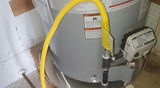
Key Factors That Affect Gas Water Heater Installation Cost
Professional installation costs split almost evenly with equipment purchase. Labor accounts for over half of your total gas water heater installation cost.
Understanding each component helps you budget accurately.
Unit Purchase Price and Brand Selection
Tank water heaters range from $300 to $2,500 before installation.
Rheem models cost $600 to $2,300 installed. Forty-gallon units start at $600. Fifty-gallon models reach $1,700.
A.O. Smith pricing runs $550 to $2,000. Bradford White sits higher at $700 to $2,500.
The best gas water heater balances upfront cost against warranty length. A $600 unit with $1,200 installation costs more than an $800 model requiring only $600 labor.
Installation Complexity and Labor Costs
Tank replacements demand $500 to $2,800 in labor. Tankless installations jump to $600 to $1,900.
Location matters considerably. Tight crawl spaces double installation time. Attics double installation time.
Switching from tank to tankless requires $150 to $2,500 in labor. Additional venting modifications add cost. Gas line modifications add cost.
Venting and Gas Line Requirements
Gas systems require proper venting. Carbon monoxide hazards make this non-negotiable.
Standard atmospheric vents need vertical metal ducting. Power vent models use electric blowers. Power vent models allow horizontal venting.
Installing new gas lines adds $260 to $820. Complete conversions reach $1,500.
Permit and Code Compliance Fees
Permits cost $25 to $300.
This protects you. Unpermitted installations void insurance claims after fires. Unpermitted installations void insurance claims after leaks.
Get a Sirius estimate by calling us today for full compliance handling.
Removal and Disposal of Old Unit
Removing your old gas water heater runs $85 to $267.
Disposal requirements vary by municipality. Many areas prohibit curbside dumping.
What to Look for in a Professional Installer
Verify Licensing and Certifications
Texas requires state-issued plumbing contractor licenses for most installations. Check your state licensing board or municipal website to verify credentials. Ask for proof during initial consultations. Licensed professionals adhere to local building codes and safety regulations, protecting your investment.
Certifications matter equally. PHCC and NASCLA credentials indicate rigorous training and adherence to industry best practices. EPA Section 608 certification proves technicians can legally handle refrigerants. Background-checked installers with at least 10 years of experience provide added confidence.
Check Warranty Coverage Options
Bradford White offers a 6-year manufacturer warranty on tanks and parts. Professional installation protects this coverage. Some installers add their own labor warranties. You might find 6-year labor coverage included at no extra cost. Home Depot backs installations with up to a 3-year labor warranty.
Without proper installation documentation, manufacturers void your entire warranty.
Compare Installation Services Included
Service providers should pull permits. They should schedule municipal inspections. They should handle code compliance.
Get a Sirius estimate by calling us today for full-service handling.
Delivery, disconnection of your old unit, installation, and testing constitute basic service.
Read Customer Reviews and References
Customer feedback reveals reliability. Strong reviews from local residents signal quality service.
Understand Gas Water Heater Maintenance Plans
Plans include system check-ups. Free service visits on covered repairs. 15% discounts on non-covered work.
Peace of mind comes from knowing help arrives when you need it.
Descision to Make for Important Daily Comfort
Three decisions matter most.
Tank versus tankless. Size for peak demand. Natural gas versus propane.
Professional installation protects your warranty. It ensures code compliance. Get a Sirius estimate by calling us today for accurate pricing tailored to your home.
The right unit installed correctly delivers reliable hot water for the next decade.
Prices above are subject to change and best to call and schedule a plumbing technician to revie your Gas Water Heater for up-to-date pricing.

How long does a gas water heater typically last?
A gas water heater typically lasts between 10 to 15 years with proper maintenance and care. This lifespan makes it crucial to choose the right unit from the start, as you'll be relying on it for over a decade of daily hot water needs.
What's the difference between a 40-gallon and 50-gallon gas water heater?
A 40-gallon gas water heater is designed for households with 2 to 3 people and delivers a first-hour rating of 65 to 70 gallons. A 50-gallon model suits homes with 3 to 6 people and provides 80 to 90 gallons in the first hour. Interestingly, both sizes cost roughly the same to operate, making the 50-gallon option a better value for growing families.
How much does it cost to install a gas water heater?
Installation costs vary based on several factors. Tank water heater installations typically range from USD 1500 to USD 3,800 in labor, while tankless installations can cost USD 1,600 to USD 5,900. Additional expenses include the unit itself (USD 600 to USD 2,500), permits (USD 25 to USD 300), and potential gas line modifications (USD 260 to USD 820).
Should I choose natural gas or propane for my water heater?
Natural gas is generally more cost-effective at USD 2.59 per gallon equivalent compared to propane's USD 3.53. If you already have a natural gas line to your home, it's the better choice. Propane burns hotter and produces more BTUs, but requires a storage tank that costs USD 300 to USD 1,000 depending on size and installation type.
How do I calculate the right size water heater for my home?
Calculate your peak hour demand by adding up all hot water usage during your busiest hour. A shower uses about 20 gallons, a dishwasher 14 gallons, and a clothes washer 32 gallons. Match this total to the water heater's First-Hour Rating (FHR). As a general rule, households need 30-40 gallons for 1-2 people, 40-50 gallons for 3 people, and 50-75 gallons for 4 people.